

Learn How To Pierce
Online Video Body Piercing Training Tutorials
Want To Become a Body Piercer?
But Nobody Will Show You How
Now You Can Train Online at Your Own Pace and Schedule
Start Now
Earning Your
Body Piercing
Certificate of Completion
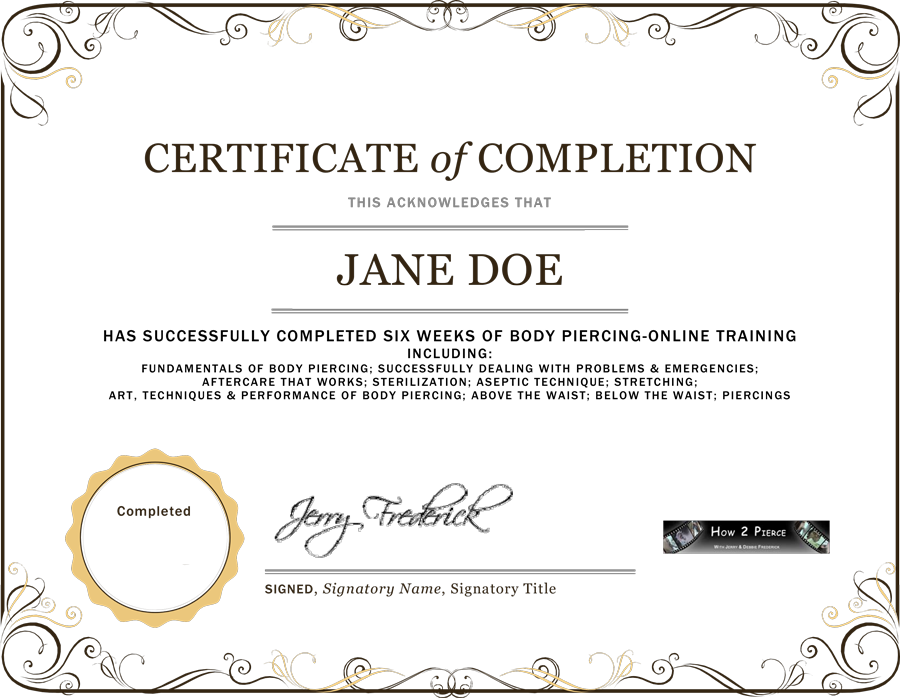
Once you verify you have completed viewing the entire body Piercing Video Library, and read the two Body Piercing books (PDF’s) you may request your certificate of completion. To be eligible for the certificate, you must be the original purchaser of the body piercing training materials. One personalized certificate per purchaser.
If you are a people-person and highly motivated, Body Piercing may be the right career for you. Instead of working in the medical/dental field, cosmetology, permanent makeup, or massage therapy, you should think about body piercing as a primary career. A new trend you may not be aware of, is that many people in these professions are finding body piercing as compatible money making addition to your current business plan.
Both women and men have equally found great success in the body piercing business. The #1 reason people don’t get into the body piercing business is lack of knowledge, expert training or coaching to help them along in the development of their career. It is virtually impossible to find a skilled body piercer to give one-on-one, hands-on training. Therefore, we have developed a comprehensive online body piercing video-training tutorial program based on our 25 years of experience.
Below are samples of the 140+ training videos. You can see the detail in which each video demonstrates the how, why, what, when and where of each piercing.
Body piercing is big . . . everybody wants to be a body piercer. But most people don’t know where to start, or they are afraid of making mistakes. Those are two very valid concerns. However, we can help you overcome your frustration of knowing where to start and your fear of making mistakes. Obviously, you want to avoid harming anyone with your body piercing efforts. Body piercing knowledge, and actually performing piercings is the only way to become a skillful body piercer. Fast track your success with the following books and demonstration videos.
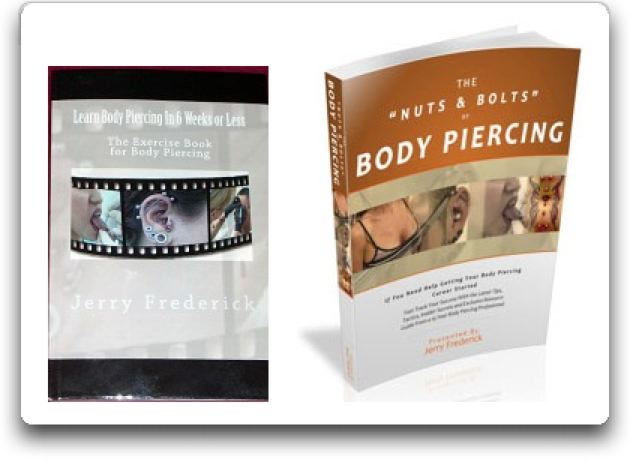
MY NEWEST TOP SELLING BODY PIERCING BOOKS ON AMAZON, & YOU CAN GET THEM FOR FREE HERE!
Learn Body Piercing in 6 Weeks or Less
The “Nuts & Bolts” of Body Piercing
I realize it is very important for you to get a quick start in your body piercing learning experience so, I wrote Learn Body Piercing in 6 Weeks or Less to give you a step by step pathway to gain the knowledge and physical skills to start piercing a real person. BODY PIERCING IS UNIQUE because you have two important things to master. One is to become knowledgeable of the human body, how to place and mark a piercing and then accomplish the PHYSICAL SKILL of completing the piercing and successfully inserting the jewelry.
Learn Body Piercing in 6 Weeks or Less is (144 pages) a self-directed learning program, for highly motivated people, to acquire the fundamentals of body piercing in 6 weeks or less. Body Piercing is a “hands-on” occupation. Six different “simulated” training tasks are demonstrated to provide proficiency in executing the physical skills of body piercing. Each “mock piercing” is a real-life simulation of actually piercing a real person. Once you finish the simulated training tasks in the book, you should be ready to start piercing a real person. The book is immediately delivered to you in digital format (PDF).
The “Nuts & Bolts of Body Piercing is 18 Chapters of high powered body piercing information that you must know, but nobody will tell you.
- The power of probing question – How to expose the truth, so you can help your client
- Cross-Contamination – how to identify and avoid
- Autoclave – why you need it – how to save money – where to buy
- Common piercing questions and how to answer them ( your income depends on it)
- Licensing and Certification Issues
- Specific details of each piercing – tips, gauge and size of jewelry
- My personal Resource List – what to get, where to get, how much it costs
- Successful Stretching Discussed
- Migration and Rejection Issue
- Bloodborne Pathogens and CPR Certification
- Dealing with problems and emergencies in the piercing room
And MUCH MORE
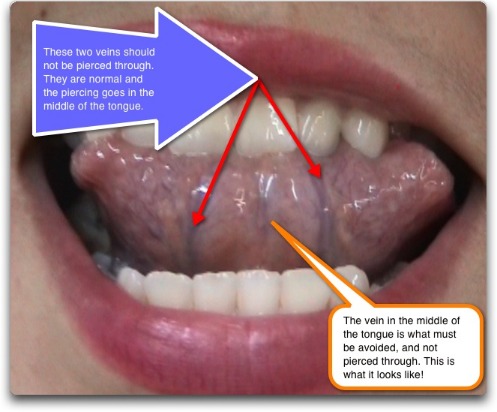
What to Look For Before Piercing the Tongue
Knowing what to look for when piercing a real person is very important information . . . the type of information you will NOT find watching YouTube Videos. You need to know what to look for, why, and how to proceed after you have observed the potential piercing area.
If you’re not making mistakes, then you’re not doing anything . . . a “doer” makes mistakes. Our body piercing demonstration videos can show you where to start, and how to avoid making big body piercing mistakes. Many people never get started because they want to be “perfect” from the very beginning. It doesn’t work that way. You get started now and become perfect later. . . that’s why they say a doctor is practicing medicine, and a lawyer is practicing law. They are always working toward perfection in their profession, just as you should be doing in your body piercing profession.
THE MOST IMPORTANT THING IN BODY PIERCING IS TO START. YOU CAN’T BE PERFECT IMMEDIATELY, BUT IF YOU WILL LEARN WHAT TO DO AND HOW TO DO IT, YOU WILL SUCCEED IN BODY PIERCING MUCH QUICKER!
What Users Of These Body Piercing Training Videos Are Saying About This Learning Experience

To start your body piercing profession, you need solid body piercing information. Watching the demonstration video above provides you a sample of how we demonstrate the skills of body piercing. Video is perfect to demonstrate the actual techniques of body piercing, as the audio describes why, how and what you are seeing. The “big” advantage of video – even over a personal trainer – is you can watch the video over and over again allowing you to fully observe the piercing at your pace and comfort level. Your learning curve is determined by watching the demonstration videos of each piercing (over 140 videos), and repeat what you saw. You can’t learn it unless you do it.
No Excuses!
Start Learning the Art of Body Piercing Today
The sample video tutorials demonstrate exactly how easy you can learn the “nuts and bolts” of body piercing. Now, you can conveniently access over 140 highly-informative and detailed body piercing video tutorials demonstrating proper body piercing procedures from start to finish.
You are invited to look over our shoulders and observe exactly how we pierce. As you observe each piercing, we describe what we are doing and why we are doing it. Wouldn’t you like to have someone help you with your body piercing efforts?
Debbie and I have been piercing full time for 25 years which gives you the benefit of 40+ years of combined body piercing experience and expertise. We have personally performed over 50,000 piercings and still work a full piercing schedule every week.
If you do not have a body piercing mentor to show you how to pierce, this is the next best way to learn how to pierce. These body piercing training videos are totally “live” . . . not staged. You see each piercing performed exactly as it happens . . . the good and the mistakes. Anyone who pierces as much as we do will occasionally have slip-ups, and you need to know how to deal with errors and overcome mistakes while keeping your client calm.
We know you can learn the mechanics of body piercing by “viewing and doing” what you just observed . . . it’s just that easy. How do we know, because that is exactly how we learned how to pierce . . . but we had only 7 videos . . . you have access to 140 videos, so your progress should be much faster than ours.
A huge benefit of using video training is you can review specific techniques repeatedly – go over and over again – until you are comfortable with the procedure. This gives you the benefit of checking your work against the videos to see how you are doing
Act Now For
Lifetime access to all of the Body Piercing Demonstration Videos (140 Videos) delivered in Streaming Video 24/7. The Video Categories are as follows: (you can view a specific description of all the videos further down this page)
- Fast Start to the Fundamentals of Body Piercing
- Piercing the Entire Ear
- Navel Piercings
- Nostril, Septum & Eyebrow piercings
- Lips, Labret, Beauty Mark & Tongue piercings
- Male & Female Nipple piercings
- Male & Female Genital Piercings
- Surface to Surface
$147 For Lifetime Access to All the Body Piercing Training Videos
Videos Play on PC – MAC – iPad- iPhone – Andriod
Great News! We have added a mentoring/coaching program to the body piercing video tutorials. The Mentoring Program runs for 6 months after you enroll in the special body piercing training package we are offering.
You will get six months of email support, coaching and mentoring for your body piercing questions. You email me your questions and I will return with an answer within 48 hours or less.
This is huge. Now you can accelerate your learning and have access to my 25 years of body piercing experience. I still pierce 6 days a week, so I cannot answer telephone questions during my work day. However, I can answer your questions by email or in some cases I may answer by phone if the issue is so complex email would make it more confusing.
Six Months of Email Mentoring/Coaching is only $100. You get everything for $247.00. The mentoring is optional, however, you must get the video tutoring to add the mentoring/coaching program. If you are not training using my program, mentoring would be useless.
$147 Video Tutorials 140
3 FREE BONUSES INCLUDED
$100 Mentoring/Coaching (Optional)
____
$247
Bonuses
3 Must Have Bonuses
For a short time I am giving you 3 very important bonuses for FREE with your Body Piercing Video Tutorials Order.
BONUS 1. LEARN BODY PIERCING IN 6 WEEKS OR LESS (pdf)
BONUS 2. THE NUTS & BOLTS OF BODY PIERCING (pdf)
BONUS 3. VERY IMPORTANT LIABILITY, CONSENT & AFTERCARE FORMS ALONG WITH BUSINESS AND OPERATIONAL FORMS.
- 35 Forms Covering the Following:
- Adult Release Forms
- Minor Release Forms
- Sales Forms
- Aftercare Forms for All Needs
- Release & Consent Forms of All Needs
More Big Benefits of Using Our Body Piercing Streaming-Video Demonstration Tutorials
You can learn at your own pace
You can learn within your personal time table, totally at your convenience
Your Videos cannot be lost or stolen
They can be viewed from any computer in the world, at any time day or night
You will have a “training resume” so to speak, if you attempt to get an apprenticeship – you will not be starting from zero knowledge – you can actually offer the prospective mentor something of value – you might even find you know more than your mentor does.
You can get exceptional body piercing knowledge on a shoestring budget (extremely low investment for your training – compare tuition for training as a Medical Assistant, Dental Assistant, Cosmetologist, or Motorcycle Mechanic) it is about 10 times less, and you can get after it and get it done now! You are in total control of your personal training . . . not some rigid, expensive school schedule.
You Can Do This . . . It’s like having your own private video tutor. We show you where to place the piercing, how to mark the piercing, select the proper jewelry and demonstrate the actual piercing . . . nothing is held back. If there are two accepted ways to do a piercing, we show you both methods of piercing.
If you have read this far that means you really want to learn how to be a responsible body piercer and follow the rules. Sadly there are no Universities, State Colleges, Community Colleges or Technical Schools where you can learn the skills and techniques of body piercing. Unfortunately, there are no industry sponsored programs to help you learn the art of body piercing either.
That leaves it up to YOU, to try and find help in your quest to learn more about how to pierce. It is obvious, if you are going to learn how to pierce, you must learn it from someone else who knows how . . . and is willing to help you.
No excuses . . . we are eager to help you establish, develop and build your skills and knowledge through our body piercing training video tutorials.
No excuses . . . you can get started at your convenience, and work at your own pace, and be in total control of your training.
No excuses . . . you can get started on a shoestring budget. You can start with only one grouping of training videos or receive a huge discount if you get the entire training package of videos and modules.
All of our body piercing experience is laid out before you . . . No Excuses . . . it’s yours if you simply take advantage of it and make it yours!
If You Are a Results Oriented Person, this body piercing demonstration program can be mastered quickly and conveniently providing you with the knowledge you need to get started and succeed in the body piercing industry.
We have eliminated all of the excuses . . . you can get started training with your body piercing video tutorials, modules and books today!
Thoughtfully, read the descriptions of each video tutorial and module below and select one or all of the body piercing training videos or modules… and then get started . . . you are the master of this training program.
Video #1 – Fast Start To The Fundamentals
Of Body Piercing Video Series
 Body piercing is like any other craft, skill, or profession, you MUST learn the fundamentals before you can function properly, and advance to higher levels of productivity and achievement. Fast Start To The Fundamentals Of Body Piercing is a rare learning experience. No where else can you find this much information directed to to building a strong foundation in the skills and techniques of body piercing. Start your body piercing career out right by starting at the beginning
Getting a fast start is very important and this series of 8 videos includes the following to help you get that fast start.
- Sterilization Methods & Techniques Video
Working off a sterile field is an extremely important aseptic technique to learn, and in this video you will learn how to create one. This video shows you how to bag your piercing tools, marking, and cleaning items so you can achieve a sterile field to work from in the piercing room. In addition you will see a great way to store your jewelry. This method allows you to economically use your jewelry resources by disassembling your jewelry and storing it in parts.
- Piercing Tools & Their Use
When you begin your piercing career, you must have a complete command of piercing tools, and what they are used for. This video goes over all the piercing tools, spreaders, tapers, and pliers you will need and what they are used for in your piercing career.
- How To Use Calipers For Measuring
To execute an accurate piercing you must measure it properly. The best way to measure it accurately is with a dial caliper. This video show you how to measure and mark with a dial caliper.
- How To Measure & Mark Your Piercings
Now that you know to use a caliper to measure and mark your piercings, you will need to apply that knowledge to select the proper jewelry, and making the proper marks for the piercing. We demonstrate how to measure the piercing and how to choose the dimensions of the jewelry appropriate for that piercing. It doesn’t get more fundamental than this. If you do not know the material on this video you will not last long in the piercing business.
- A Bio-Hazard Room Setup
If you are a new piercer, a bio-hazard room is an area where you process your dirty piercing items and tools after a piercing. The piercing items are processed from dirty to sterile in this room and the object of this process it to avoid cross-contamination of your sterile items. This very important video shows how you can set-up a methodical process to avoid cross-contamination in your bio-hazard room.. If you do not know how to properly setup a bio-hazard room, this video is a must for excellent suggestions.
- Using A Practice Board For Mock Piercings
When you are new, it is very hard to find someone to practice piercing on. This video shows you how to build a piercing practice board so you can practice piercing without a human being to practice on. Excellent way to develop you piercing skills.
- Practice Piercing Angles
In practically every piercing you must deal with an angle. This video teaches you how to practice your angles and make your needle come out where you expect it to come out. Not knowing how to hit the proper exit mark is why you see many piercing either too shallow or too deep.
- How To Avoid A Sore Finger
It takes a lot of practice before you begin piercing on a person. That practice can make you finger very sore. This video shows you how to take care of that sore finger while toughening up your finger.
Video #2 – Ear Piercings (All Areas of the Ear)
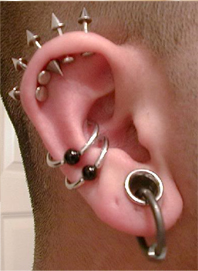 WOW, ear piercings are becoming much more popular. Creative ear piercing is a great way to increase your body piercing business and create a new profit center. When employers get tough on facial piercings, it is harder for them to crack down on ear piercings. In addition, new ear jewelry is becoming less expensive and more available. There are many more options with the new “micro labret studs” with gem ends for the tragus, cartilage, and lobe piercings.
Learn how to pierce every area of the ear. You will view the following piercings in this videos: Lobes, Orbital, Cartilage, Tragus, Dbl. Tragus, Quadruple Tragus, Conch, Conch Stretch, Single and Double Industrials on Same Side, Anti Helix, and Helix
We explain each piercing in detail. I perform piercings one way and Debbie does some differently. This really gives you an advantage of seeing different piercing techniques on the same piercing.
Video #3 – Nipples (Male & Female)

Learn how to correctly mark and pierce nipples is a must for every piercer. Manipulating the nipple in an appropriate way to avoid excessive movement is an important technique you will learn in this video.
This video is 30 minutes long with 20 nipple piercings. You will learn how to pierce a male nipple without getting it too deep. This video also demonstrates the proper piercing of a male inverted nipple. We also show you how to match up a botched piercing and make the other nipple piercing look like they were both intended to be pierced that way.
Many people are interested in the female vertical nipple piercing. We demonstrate this piercing technique as well as the female cross nipple piercing.
Video #4 – Navel Piercings
 The navel piercing video covers more than 20 navel piercings. It takes you from start to finish. You will see how to mark the many different types of navels. In your studio you will get many different types of navels from the ultra, skinny “Donut Navel”, to the complex “Deep Sloping Navel”. You will observe the marking and piercing of these navel piercings while we discuss what we are doing as we do it.
You will also see advanced navel piercings. Correct marking on multiple navel piercings is vital to a successful piercing. You will see– and we will discuss:
- The marking and piercing of a top and bottom navel piercing
- A triple across the top navel piercing
- Four piercings around the navel
Let’s be frank, navel piercings are the backbone of most piercing studios. The navel piercing is the most performed piercing, and the piercing with the most healing problems. Most of those healing problems occur because of inappropriate jewelry selection for the piercing. Most piercers either pierce too much or too little tissue. The vast majority of healing problems I see are because the piercer pierced TOO MUCH tissue, and inserted TOO SMALL a diameter of jewelry into the piercing.
Video #5 – Surface To Surface Piercings

Surface to surface piercings are becoming more popular with the better design of jewelry for this piercing allowing more successful healing.
You will see examples of the nape, valley, wrist and navel surface to surface piercings. If you master these piercings you can do any surface piercing. The key is learning how to mark the piercing for the unique surface barbell. You may want to do the free-hand piercing or pierce it with a clamp. You will see both. Watch how to successfully insert jewelry into this difficult piercing.
Video #6 – Genital Piercings (Male & Female)

This video is very helpful to you with our discussions of the placement of genital piercings. You will see specific diagrams to give you clear view of the proper placement.
We perform many piercings in this video. You will see and hear us discuss the following piercings:
- Frenum
- Triple Frenum Ladder
- Six Frenum Ladder
- Prince Albert
- Apadravya
- Ampallang
- Female Horizontal Hood Piercings
- Female Vertical Hood Piercing
- Reverse Prince Albert Scrotal Piercing
- Foreskin Piercing
- Didoe Piercing
Video #7 – Tongue Piercing
 The tongue piercing video demonstrates how to mark the tongue for piercing. You will see a very educational diagram of the tongue showing the placement of nerves in the tongue.
In addition you will see how to observe the placement of veins in the bottom of the tongue. You will readily see why the tongue is pierced where it is and how potentially dangerous piercing the tongue in the wrong place can be. Many piercers are afraid to pierce a short tongue. You will see how it is done along with a discussion of the jewelry selection for a short tongue. Multiple tongue piercings are also demonstrated.
Video #8 – Labret, Beauty Mark & Lip
 The lip piercings in the video are done with rings. The labret piercings are done with a labret stud. We demonstrate how to do single and double lip piercings.
You will see the piercings performed inside out and outside in. We do the labret piercings from both angles, inside out and outside in. Again, once you see the two methods performed you can decide which way is best for you.
The beauty mark video is the best demonstration of how to mark, line up and pierce I have ever seen. You will see exactly how to analyze the marking in relation to the lip, cheek and eye. This is a piercing that is stunning if done properly. Then you will see how to line up your needle from the left side and the right side. The procedure is different depending on which side you are piercing. If you do not get this piecing lined up correctly it will look horrible, and you do not want people walking around with a botched beauty mark on their upper lip.
Video #9 – Nostril, Eyebrow & Septum
 Bending a nostril screw correctly can be easily mastered. We demonstrate exactly how to bend the nostril screw for the LEFT and RIGHT nostril.
The nostril screw is bent differently for each side of the nose. The nostril is becoming almost as popular a piercing as the navel, so it is important to know how to perform a great nostril piercing.
Many piercings can be performed different ways. The eyebrow is a great example of a piercing that can be done two different ways. You will see me do the eyebrow piercing freehand, and Debbie does it with a clamp. You will see both performed and then you can decide with style is best for you. We do all the marking and measuring of the eyebrow for you to see, as well as a double eyebrow piercing and marking.
The septum piercing can be performed either freehand or with a clamp. Debbie demonstrates the freehand method and I demonstrate the clamp method. This is a piercing that can eat your lunch if you do not know how to do it.